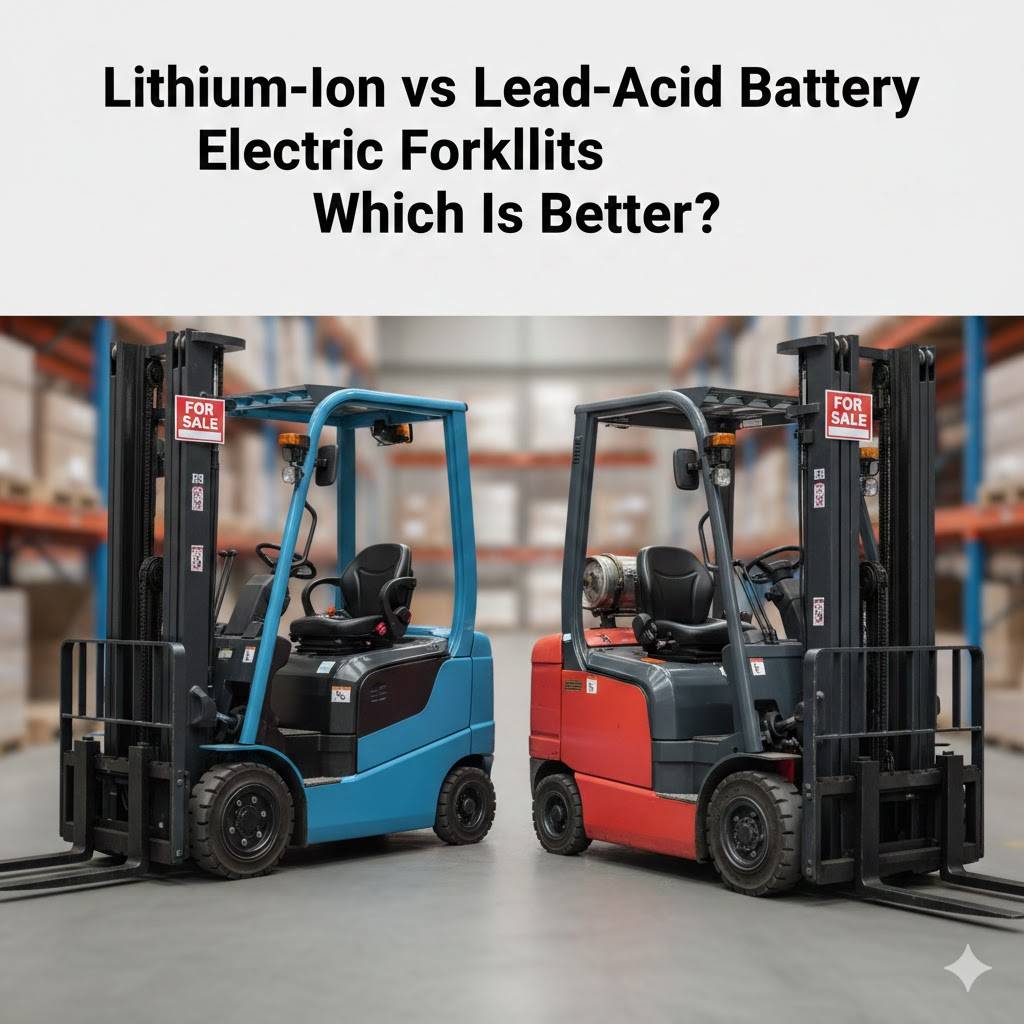
When investing in an electric forklift for sale, the single most significant long-term decision isn’t just the model itself—it’s the battery technology powering it. As warehouse operations prioritize efficiency, total cost of ownership, and sustainability, the debate between traditional lead-acid and advanced lithium-ion batteries intensifies.
Choosing the right power source impacts everything from your upfront budget to daily productivity. This analysis cuts through the hype to provide a clear, operational comparison, helping you determine which forklift truck truly offers better value and performance for your specific needs.
The Core Technologies: Understanding the Power Behind Your Forklift
Lead-acid is the established workhorse, a technology reliant on liquid electrolytes and requiring regular maintenance, watering, and controlled charging cycles. In contrast, lithium-ion represents a modern solid-state solution.
These are sealed, “fit-and-forget” units with integrated Battery Management Systems (BMS) that optimize performance and lifespan. This fundamental difference sets the stage for all operational comparisons.
Head-to-Head Comparison: Where Each Technology Excels
Let’s break down the key decision-making factors:
- Upfront Cost: Lead-acid wins clearly. The initial purchase price of both the battery and the electric forklift itself is lower. However, this is just the entry ticket. Lithium-ion commands a premium of 2-3 times the cost of a lead-acid battery.
- Total Cost of Ownership (TCO): Here, lithium-ion often triumphs over time. Factor in the elimination of battery changing rooms, reduced labor for maintenance and watering, zero spending on replacement batteries for multi-shift operations (thanks to opportunity charging), and vastly superior energy efficiency (up to 30% less electricity consumed). For intensive use, the ROI becomes compelling within 2-3 years.
- Performance & Productivity: Lithium-ion provides consistent voltage from 100% to near-zero charge, meaning no power drop throughout a shift—your fork truck operates at full strength until it needs a recharge. They also enable “opportunity charging” during breaks without memory damage. Lead-acid batteries require full-cycle charges in a dedicated space and experience declining power as they deplete, potentially slowing work at the end of a shift.
- Maintenance & Infrastructure: Lithium-ion is virtually maintenance-free. Lead-acid requires weekly watering, terminal cleaning, and specific charging rooms with ventilation due to off-gassing. This saves significant space and labor costs.
- Lifespan & Warranty: A quality lithium-ion battery often lasts 2-3 times longer than a lead-acid set under similar conditions, with warranties frequently covering 7-10 years or thousands of cycles.
Operational Scenarios: Making the Right Choice for Your Business
- Choose Lead-Acid If: Your capital budget is extremely tight upfront, your operation is single-shift with low usage, and you have established infrastructure and procedures for battery management. It remains a cost-effective solution for lighter-duty applications.
- Choose Lithium-Ion If: You run multi-shift operations (24/5 or 24/7), value maximizing uptime and productivity, aim to reduce your facility’s carbon fork truck for sale footprint and energy costs, and want to free up floor space. It is the definitive choice for demanding, high-throughput environments.
The Verdict: It’s About Operational Intelligence
So, which is better? It depends on your definition of “better.”
- Lead-acid is better for minimizing initial purchase price.
- Lithium-ion is better for minimizing long-term operational cost, maximizing productivity, and enabling a modern, efficient warehouse.
For operations focused on future-proofing their investment, the intelligence of lithium-ion technology is increasingly undeniable. The higher initial investment buys predictable performance, radical simplicity, and a lower true cost over the asset’s life.
FAQs: Electric Forklift Battery Technology
Q1: Can I retrofit my existing electric forklift with a lithium-ion battery?
A: Often, yes. Many forklifts for sale originally equipped with lead-acid can be retrofitted with a compatible lithium-ion conversion kit. It’s a significant upgrade that can breathe new life and performance into a reliable truck. Consult with your dealer for compatibility.
Q2: Is the safety profile different between the two battery types?
A: Both are safe when handled properly. Lithium-ion batteries have sophisticated BMS that prevent overcharging and overheating. Lead-acid batteries require care due to their acidic electrolyte and hydrogen off-gassing during charging, necessitating a ventilated room.
Q3: How does the resale value compare for forklifts with different batteries?
A: An electric forklift for sale equipped with a long-life lithium-ion battery typically holds a significantly higher resale value. The knowledge that the next owner won’t face imminent battery replacement costs is a powerful value driver in the used market.
 Paves Asia Pacific
Leave a comment