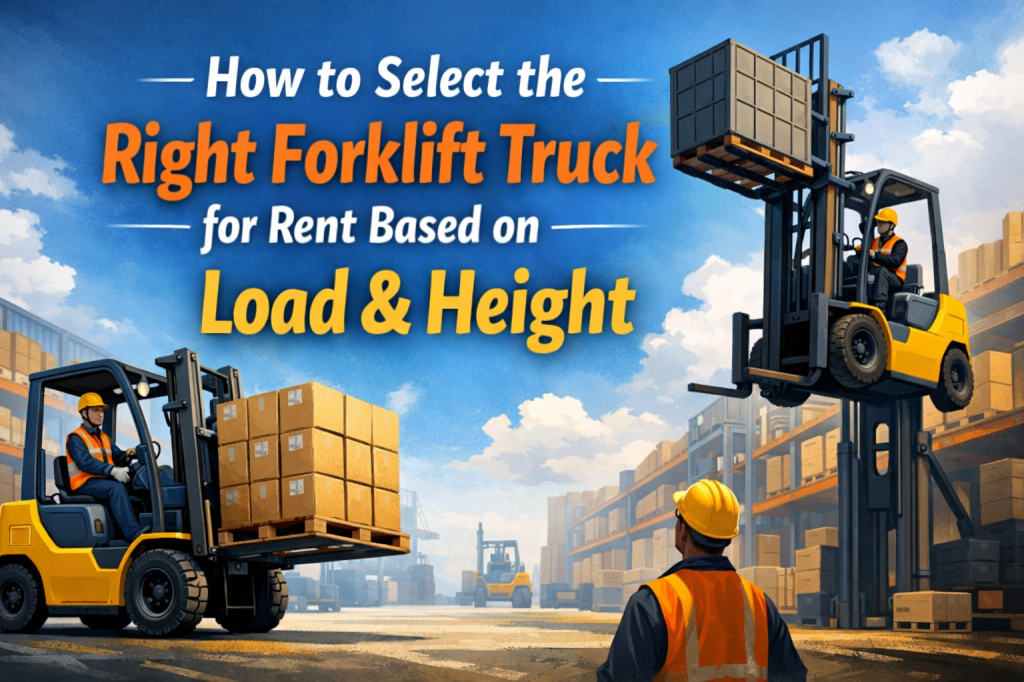
Selecting the correct forklift for rent is a critical decision that impacts warehouse efficiency, workplace safety, and operational costs. In high-density logistics hubs, the margin for error is minimal; using a truck with insufficient lift height halts production, while excessive load capacity often leads to unnecessary rental premiums.
When searching for forklift rental services Singapore, understanding your load capacity and lift height requirements is the first step toward operational efficiency. Unlike purchasing, renting offers flexibility, but only if you match the machine precisely to the task.
This guide breaks down the technical selection process for businesses seeking forklift rental services, ensuring you maximize throughput without overspending on unused power.
Understanding the Load Capacity Spectrum
The load capacity—measured in kilograms or tones—refers to the maximum weight a forklift can safely lift at a standard load center (typically 500mm or 600mm).
Selecting the right capacity is not simply about whether the forklift can move the load; it is about whether it can move it safely at the required height.
Light-Duty Operations (1.0 – 2.0 tonnes)
For facilities handling palletized retail goods, electronics, or food products, a Class III electric forklift is often the optimal choice. If you are located in the western or eastern industrial estates and require forklift rental near me with quick turnaround, these trucks offer precision and zero emissions.
They are ideal for indoor loading docks where ground conditions are smooth and ramp gradients are minimal.
Medium-Duty Operations (2.5 – 5.0 tonnes)
This is the most common segment for general manufacturing and wholesale distribution. These forklifts handle consolidated pallets of hardware, building materials, or beverage crates. Most warehouse forklift rental inquiries fall into this category, particularly for facilities with racking systems between 4 and 6 meters.
Heavy-Duty Operations (8.0 – 16.0+ tonnes)
Heavy industries such as precast concrete, steel fabrication, and marine logistics require robust internal combustion (IC) engines. These industrial forklift rental units are built with larger tires and counterweights to handle uneven terrain.
In Singapore’s shipyard and petrochemical sectors, load capacities often exceed 16 tonnes to move wind turbine components or large machinery skids.
Evaluating Lift Height and Free Lift
Lift height is often misunderstood by first-time renters. The maximum lift height is the height to which the forks can raise the load, not the height of the forklift itself. For standard warehouse racking, a 5-meter lift is usually sufficient for double-stacking.
However, modern high-density storage now requires lifts of 7 to 10 meters.
Free Lift is Critical for Container Work
If your operation involves loading containers or trailers, you must consider “free lift.” This is the height the forks can rise before the mast starts to extend. Standard masts begin extending immediately, which can cause the overhead guard to hit the container ceiling.
A three-stage mast with full free lift allows the operator to stack inside a container without risking structural damage. When inquiring about electric forklift rental, specifically ask whether the unit offers full free lift if container work is involved.
Indoor vs. Outdoor: Matching Power Source to Terrain
One of the biggest differentiators in forklift hire services is the power source. Your choice here directly correlates with load management and height consistency.
Electric Forklifts (Battery-Powered)
Electric models are preferred for indoor warehouse forklift rental due to their silent operation and zero fumes. Modern lithium-ion batteries offer opportunity charging, meaning the truck can be charged during lunch breaks to maintain shift work without battery swaps.
They excel in clean environments like cold storage or pharmaceutical warehouses. However, they generally have lower ground clearance and are not suitable for wet or muddy construction sites.
Internal Combustion (Diesel/LPG)
For outdoor lumber yards or recycling centers, diesel forklifts provide superior torque and gradeability. LPG models offer a compromise; they burn cleaner than diesel but still deliver the power required for rough surfaces.
If your rental period coincides with Singapore’s monsoon season, an IC truck with pneumatic tires is essential to prevent bogging.
Analyzing the Load Chart
Every forklift has a load capacity chart mounted on the dashboard. Relying solely on the model name (e.g., “3-tonne forklift”) is risky. A 3-tonne forklift is only rated for 3,000 kg if the load is centered correctly and the mast is vertical.
If the load is off-center or you are using attachments (such as side shifters or rotators), the capacity decreases significantly.
When you contact forklift rental services Singapore, request the specific data plate of the unit you intend to rent. If you are lifting to 7 meters, the capacity may drop by 30% to 40% compared to its ground-level rating. This phenomenon, known as “capacity deration,” is the primary cause of tip-overs.
Comparing Electric vs. Industrial Forklift Rental Options
When narrowing down your equipment list, you will likely compare electric and industrial models. Electric forklift rental is generally recommended for facilities with strict noise regulations or indoor air quality certifications (e.g., LEED-certified buildings).
They offer lower total daily operating costs because electricity is cheaper than diesel, and maintenance intervals are longer.
Conversely, industrial forklift rental (diesel/LPG) remains the standard for operations that never stop. If your facility runs 24/7 and cannot pause for battery charging, the quick refueling time of IC engines keeps productivity at peak.
Additionally, IC engines perform better on sustained ramp climbs, whereas electric motors risk overheating if used continuously on steep gradients.
Assessing Site Conditions and Clearance
Before finalizing a rental agreement, physically measure your facility’s door heights, aisle widths, and elevator capacities (if changing floors).
A common mistake is renting a counterbalance forklift with a 3-meter lift height, only to realize the mast is 2.5 meters tall when collapsed—and the warehouse door is only 2.4 meters high.
For facilities with limited maneuvering space, a reach truck (a subset of warehouse forklift rental) is often superior to a counterbalance truck. Reach trucks have outriggers that stabilize the load, allowing narrower aisles. However, they are strictly for indoor use on smooth floors.
The “Paves” Consideration in Rental Agreements
While many providers offer standard contract terms, it is vital to read the fine print regarding wear and tear versus damage. A reputable company like Paves emphasizes pre-rental inspections to ensure both parties agree on the machine’s condition.
This prevents disputes when returning the unit. Always photograph the tire tread and fork blade thickness before taking the forklift on-site. Following a checklist similar to those used by Paves ensures you only pay for actual usage, not pre-existing damage.
Operational Efficiency and Attachment Selection
Do you need a forklift simply to move pallets, or do you need one to rotate bales, clamp cartons, or push snow? Attachments drastically change the capacity and lift height. A side-shifter adds approximately 100 kg to the fork weight, reducing the net capacity.
A rotator adds even more weight. If your application requires unusual handling, inform the forklift hire services provider immediately so they can supply a truck with a higher base capacity to compensate.
Logistics and Delivery
When searching for forklift rental near me, proximity matters. Transport costs for heavy machinery are significant.
Providers located within the same industrial estate can often deliver within 2 hours, whereas cross-island deliveries may require a low-bed trailer costing upwards of $200. Clarify whether the quoted rental rate includes delivery and collection, or if it is strictly the machine rate.
Maintenance and Breakdown Support
Machines break down. Hydraulic hoses burst, and batteries drain. The difference between a good rental experience and a terrible one is the response time to breakdowns.
Leading forklift rental services offer guaranteed response times (e.g., 4 hours) within mainland Singapore. Ensure the contract specifies loaner unit availability if the repair is extensive.
Frequently Asked Questions (FAQs)
1. How do I calculate the exact load capacity I need for my forklift rental?
Take the heaviest pallet weight you handle and add 25% as a safety margin. For example, if your pallets weigh 1,600 kg, rent a 2,000 kg (2-tonne) forklift. This buffer accounts for dynamic forces during turning and uneven load distribution.
2. Can I rent a forklift for a single day in Singapore?
Yes, daily rentals are available. However, minimum rental periods often apply, and transport costs may outweigh the benefit for a single day. For very short-term needs, confirm if the provider offers half-day rates or weekend specials.
3. What is the most common lift height for warehouse forklift rental in Singapore?
The majority of standard warehousing operates at 4 to 5 meters. High-reach trucks can extend to 10 meters, but these require wider aisles and specialized operator licensing.
4. Is it cheaper to rent an electric forklift or a diesel forklift?
Daily rental rates are often similar, but electric forklifts are cheaper to “fuel.” If your facility has the infrastructure to charge batteries overnight, electric rental provides long-term savings despite a potentially higher base rate.
5. What happens if the forklift breaks down during the rental period?
Reputable providers include breakdown coverage. You should not be charged for mechanical failure inherent to the machine. Always clarify liability for wear items like tires or bulbs, as these are sometimes considered consumables.
 Paves Asia Pacific
Leave a comment