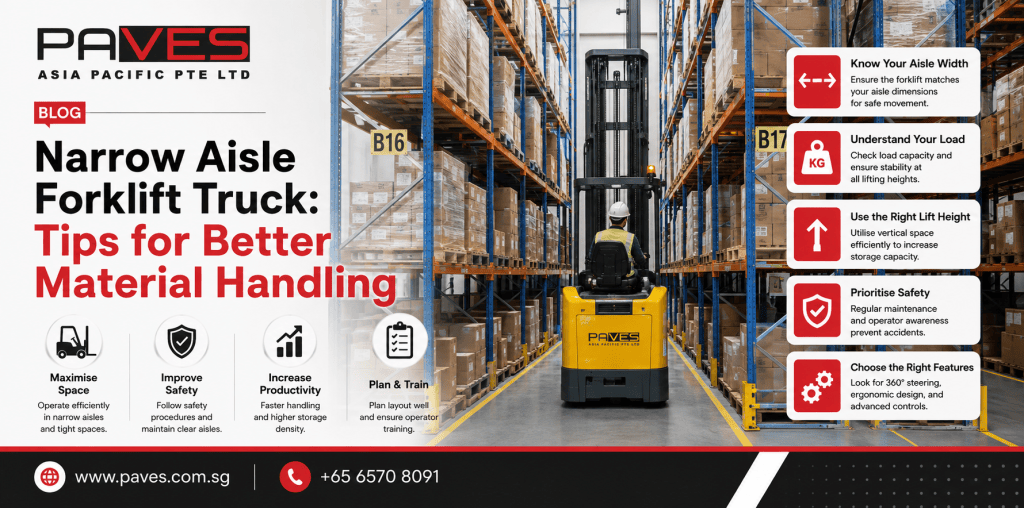
A narrow aisle forklift truck is designed to work in restricted spaces, helping warehouses improve storage density, accessibility, and material movement.
For businesses managing high-density storage, choosing the right forklift is only the first step. Operator training, aisle planning, load management, maintenance, and proper racking design also have a major impact on performance.
1. Understand Your Warehouse Layout
Before purchasing or renting equipment, assess the complete warehouse layout. Measure aisle widths, rack heights, turning areas, floor conditions, loading zones, and pedestrian routes.
A forklift that fits one section of a warehouse may not be suitable for every operating area. Consider the narrowest aisle, highest storage position, average load dimensions, and required lifting height when comparing equipment.
A well-planned layout allows forklifts to operate without unnecessary reversing, repositioning, or congestion. It can also help improve travel routes and reduce wasted movement.
2. Choose the Right Forklift Configuration
Different warehouse applications require different forklift designs. A Narrow aisle forklift can be suitable for facilities where conventional counterbalance equipment requires excessive operating space.
For applications involving long or awkward loads, a multidirectional forklift may offer additional flexibility. Businesses researching a Combilift forklift Singapore option should consider load dimensions, turning requirements, lifting height, and operating environment rather than focusing only on purchase price.
For very high-density warehouses, a VNA solution may provide another option where aisle widths are extremely restricted. Buyers considering a VNA forklift for sale should compare specifications against their existing racking and floor layout.
3. Match Forklift Capacity to Your Loads
Selecting equipment with insufficient capacity can create serious safety and productivity concerns. Determine the typical load weight, maximum load weight, load centre, dimensions, and lifting height before making a decision.
Never assume that a forklift’s maximum rated capacity applies equally at every lifting height. Capacity can vary depending on load centre, mast configuration, attachments, and lift height.
Create clear load-handling procedures so operators know the correct capacity limits. Loads should remain stable and evenly positioned on the forks during transportation.
4. Optimise Racking and Storage Positions
The forklift and racking system should work together. Narrow aisles are most effective when storage locations are planned to accommodate the forklift’s turning and lifting requirements.
Use consistent pallet positions and clearly marked storage locations. Avoid placing pallets outside designated areas because even small obstructions can reduce usable aisle space.
Vertical storage can increase warehouse capacity, but higher racks require careful consideration of lift height, visibility, floor conditions, and load stability.
5. Train Operators for Precision Handling
Operating in a restricted aisle requires greater precision than working in a spacious warehouse. Operators should understand steering controls, turning clearances, load stability, pedestrian awareness, and rack positioning.
Training should include practical exercises for:
- Entering and exiting narrow aisles.
- Positioning forks accurately.
- Picking and placing pallets.
- Handling loads at different heights.
- Approaching rack locations safely.
- Reversing where visibility is limited.
- Maintaining safe speeds.
- Responding to pedestrians and other equipment.
Regular refresher training can help reinforce safe operating habits.
6. Improve Visibility and Communication
Restricted aisles can make visibility more challenging, particularly when loads are elevated or large. Operators should maintain clear sightlines wherever possible and follow established warehouse communication procedures.
Mirrors, warning signs, floor markings, lighting, and designated pedestrian routes can support safer movement. Where visibility is restricted, operators should follow the site’s specific procedures for travelling and positioning loads.
Good communication between forklift operators, warehouse staff, and supervisors can also reduce unnecessary congestion.
7. Maintain Safe Travel Speeds
Higher speed does not necessarily mean better productivity. Excessive speed can increase stopping distances, load instability, and collision risk.
Set appropriate operating speeds based on aisle width, floor conditions, traffic levels, load characteristics, and site rules. Operators should slow down at intersections, rack ends, pedestrian crossings, and areas with limited visibility.
Smooth acceleration and braking can also help protect loads and reduce unnecessary wear on the equipment.
8. Keep Aisles Clear and Organised
A Narrow aisle warehouse forklift leaves little room for unexpected obstacles. Pallets, packaging materials, tools, and other objects should never be stored in travel paths.
Implement routine aisle inspections to identify damaged pallets, uneven flooring, debris, rack damage, or other hazards. Mark emergency exits and keep them accessible.
Warehouse housekeeping is particularly important in high-density environments because even a small obstruction can interrupt forklift movement and create avoidable risks.
9. Use Preventive Maintenance
Regular maintenance helps keep material-handling equipment reliable and ready for operation. Follow the manufacturer’s inspection and maintenance recommendations.
Operators should check essential components before use, including tyres or wheels, forks, mast components, brakes, steering, warning devices, hydraulic systems, and battery or charging systems where applicable.
Any unusual noise, leakage, steering issue, braking problem, or visible damage should be reported promptly. Preventive maintenance can reduce unexpected downtime and help identify developing problems before they become more expensive.
10. Review Performance Regularly
Improving material handling is an ongoing process. Track useful operational indicators such as pallet movements, travel time, equipment downtime, damage incidents, maintenance frequency, and storage utilisation.
If operators frequently need to reposition equipment or wait for access to an aisle, the warehouse layout may need adjustment. Reviewing these patterns can reveal opportunities to improve workflow.
Businesses can also compare equipment performance over time to determine whether their current solution continues to meet operational requirements.
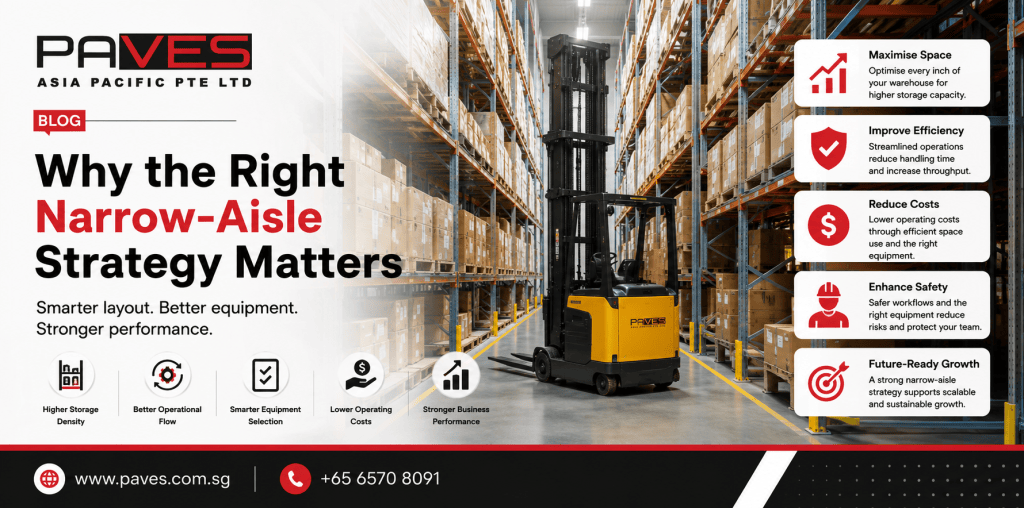
Why the Right Narrow-Aisle Strategy Matters
A well-selected forklift can support better use of warehouse floor space, but equipment alone does not create an efficient operation. Warehouse design, racking, operator skills, load planning, traffic management, and maintenance must work together.
For Singapore warehouses, local operating conditions and available service support should also be considered when comparing equipment. Paves can help businesses evaluate material-handling requirements and identify equipment suited to their warehouse applications.
FAQs
What is a narrow aisle forklift used for?
It is designed for moving, lifting, and storing palletised loads in warehouse aisles where conventional forklifts may have limited manoeuvring space.
How narrow can forklift aisles be?
The required aisle width depends on the specific forklift model, load dimensions, steering configuration, rack design, and operating method. Always follow the manufacturer’s specifications.
Is a Narrow aisle warehouse forklift suitable for high-density storage?
Yes. These forklifts can be particularly useful in high-density warehouses because their compact operating requirements can allow more storage space to be allocated to racks.
What should I check before buying a VNA forklift for sale?
Check aisle width, rack height, maximum load weight, load centre, lift height, floor conditions, operator requirements, battery requirements, service support, and compatibility with your existing warehouse layout.
Conclusion
Better material handling in restricted warehouse spaces starts with careful planning. Assess aisle dimensions, load requirements, lifting heights, racking configuration, operator needs, and maintenance requirements before selecting equipment.
The right combination of forklift technology, warehouse organisation, trained operators, and preventive maintenance can improve space utilisation while supporting safe and consistent material movement. Paves can also assist businesses in reviewing suitable material-handling solutions based on their operational requirements.
For More Details :
Contact No : +65 6570 8092
E – Mail : sales@paves.com.sg
 Paves Asia Pacific Pte LTD
Leave a comment