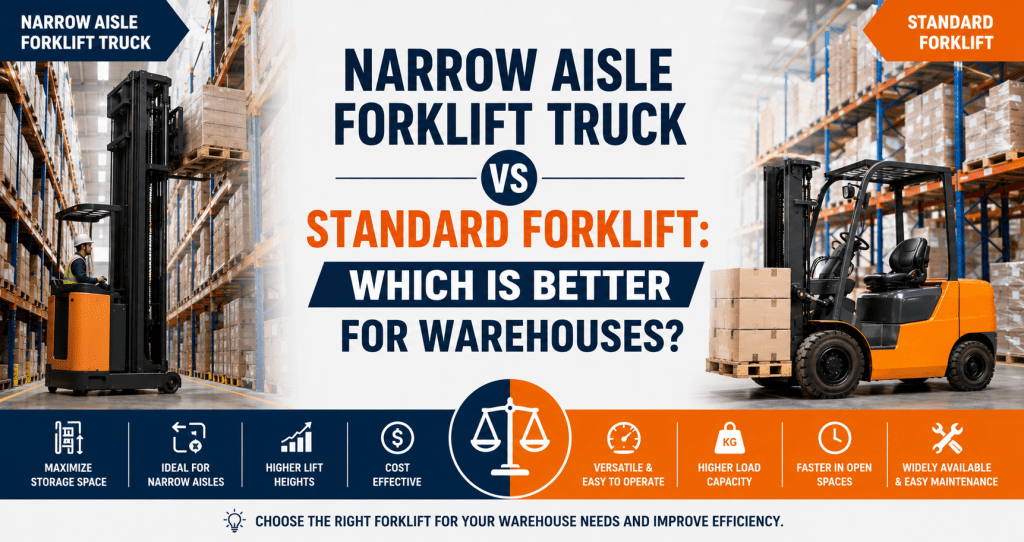
Warehouses today are under constant pressure to maximize storage capacity, improve productivity, and reduce operational costs. Choosing the right material handling equipment plays a major role in achieving these goals. Among the most common options are the narrow aisle forklift truck and the standard forklift. While both are designed to move heavy loads efficiently, they serve different warehouse layouts and operational needs.
A narrow aisle forklift truck is specifically built to operate in tight warehouse aisles where space optimization is essential. On the other hand, standard forklifts are better suited for open spaces, outdoor applications, and general-purpose material handling.
Businesses that rely on efficient inventory movement often compare these two options before deciding whether to invest in equipment ownership or use forklift truck rental services for flexibility.
Modern warehouses are increasingly turning to the narrow aisle fork truck because it allows higher storage density without requiring a larger facility. In high-volume distribution centers, very narrow aisle forklift trucks can significantly improve space utilization and workflow efficiency.
Popular models such as the aisle master forklift are designed to maneuver easily in compact storage environments while maintaining lifting performance and safety. Whether you manage a retail warehouse, manufacturing unit, or logistics hub, selecting the right aisle forklift truck can directly impact productivity and operational costs.
This guide compares narrow aisle forklifts and standard forklifts to help warehouse operators choose the best solution for their business needs.
What Is a Narrow Aisle Forklift Truck?
A narrow aisle forklift truck is a specialized forklift designed for warehouses with limited aisle space. Unlike traditional forklifts, these machines can operate efficiently in aisles as narrow as 1.6 to 2 meters.
They are commonly used in:
- High-density warehouses
- Distribution centers
- Cold storage facilities
- Retail inventory storage
- Manufacturing warehouses
These forklifts are engineered for precision maneuvering and high stacking capabilities, making them ideal for maximizing vertical storage space.
Key Features
- Compact turning radius
- Higher lifting heights
- Improved warehouse space utilization
- Better inventory accessibility
- Efficient indoor operation
Many businesses choose an aisle master forklift because of its flexibility in handling both narrow aisle operations and standard warehouse tasks.
What Is a Standard Forklift?
A standard forklift is a versatile material handling vehicle designed for general warehouse and outdoor operations. These forklifts require wider aisles for movement and are commonly used for loading docks, shipping yards, and open storage areas.
Standard forklifts are widely used because they:
- Handle heavier loads
- Operate well on uneven surfaces
- Support indoor and outdoor use
- Are easier for general operations
Although they provide excellent lifting power, they may not be the best option for warehouses where storage density is a priority.
Which Forklift Is Better for Warehouse Space Optimization?
If warehouse space is limited, a narrow aisle forklift truck is usually the better choice. These forklifts allow businesses to reduce aisle width and add more storage racks.
Benefits include:
- Increased pallet positions
- Better inventory organization
- Improved warehouse flow
- Reduced need for warehouse expansion
For businesses operating in urban areas where warehouse space is expensive, very narrow aisle forklift trucks can deliver significant long-term savings.
Performance Comparison
Narrow Aisle Forklift Performance
A narrow aisle fork truck excels in compact warehouse environments. Operators can move quickly through tight aisles while accessing higher shelves safely.
Performance advantages include:
- Faster inventory retrieval
- Reduced travel distance
- Improved vertical stacking
- Better warehouse efficiency
However, these forklifts are generally optimized for indoor use and smooth warehouse floors.
Standard Forklift Performance
Standard forklifts perform best in mixed-use environments. They can move heavier loads and handle rougher surfaces, making them ideal for:
- Outdoor logistics yards
- Construction material handling
- Shipping and receiving operations
- Heavy-duty industrial use
They may not offer the same storage efficiency as narrow aisle forklifts, but they remain highly versatile.
Cost Considerations
Budget is an important factor when selecting warehouse equipment.
Narrow Aisle Forklift Costs
Specialized equipment typically comes with higher purchase costs. However, businesses often recover these costs through improved storage efficiency and productivity.
Expenses may include:
- Operator training
- Warehouse layout modifications
- Specialized maintenance
Standard Forklift Costs
Standard forklifts generally have lower upfront costs and wider availability. Maintenance and parts are also easier to source.
For businesses with seasonal demand, forklift truck rental services can help reduce capital investment while maintaining operational flexibility.
Safety and Operator Training
Safety is critical in warehouse operations. Both forklift types require proper training, but narrow aisle forklifts often need more specialized operator skills because of limited maneuvering space.
Narrow Aisle Forklift Safety Benefits
- Better stability in narrow aisles
- Enhanced visibility systems
- Precision steering controls
- Reduced warehouse congestion
Standard Forklift Safety Benefits
- Simpler operation for general tasks
- Better suited for outdoor environments
- Easier training for new operators
Regular maintenance and operator certification are essential regardless of forklift type.
Which Industries Benefit Most From Narrow Aisle Forklifts?
Industries with high inventory volume and limited warehouse space benefit the most from narrow aisle solutions.
Examples include:
- E-commerce warehouses
- Retail distribution centers
- Pharmaceutical storage
- Automotive parts warehousing
- Food and beverage logistics
An aisle forklift truck is especially useful when vertical storage expansion is more practical than moving to a larger facility.
When Should You Choose a Standard Forklift?
A standard forklift may be the better option if your operations involve:
- Outdoor material handling
- Heavy pallet movement
- Construction applications
- Wide warehouse aisles
- Multi-purpose industrial tasks
Businesses with less storage pressure often find standard forklifts more practical and cost-effective.
Why Many Warehouses Prefer Hybrid Solutions
Some warehouses combine both forklift types to maximize efficiency. Narrow aisle forklifts manage indoor storage operations, while standard forklifts handle loading docks and outdoor logistics.
This hybrid strategy provides:
- Better operational flexibility
- Improved warehouse productivity
- Lower workflow bottlenecks
- Enhanced inventory management
Companies like Paves often recommend evaluating warehouse layout, pallet volume, and inventory turnover before selecting equipment.
FAQs
What is the advantage of a narrow aisle forklift truck?
A narrow aisle forklift truck improves warehouse storage density by operating efficiently in compact aisles and reaching higher storage levels.
Are very narrow aisle forklift trucks suitable for small warehouses?
Yes, very narrow aisle forklift trucks are ideal for warehouses with limited space and high storage requirements.
Is forklift truck rental better than buying?
Forklift truck rental is beneficial for seasonal businesses, temporary projects, or companies wanting lower upfront investment.
What makes an aisle master forklift popular?
An aisle master forklift offers excellent maneuverability, flexibility, and efficient operation in narrow warehouse aisles.
Can standard forklifts work in narrow aisles?
Standard forklifts generally require wider aisles and may not perform efficiently in compact warehouse layouts.
Which forklift is better for warehouse productivity?
The best option depends on warehouse size, storage density, and operational requirements. Narrow aisle forklifts are usually better for high-density indoor storage.
Conclusion
Choosing between a narrow aisle forklift truck and a standard forklift depends on your warehouse layout, inventory volume, and operational goals.
Narrow aisle forklifts are excellent for maximizing storage capacity and improving efficiency in compact warehouse environments. Standard forklifts remain a reliable choice for versatile indoor and outdoor operations.
Businesses evaluating long-term warehouse efficiency should carefully assess aisle width, lifting requirements, and future expansion plans before making a decision.
Paves supports businesses with reliable material handling solutions designed to improve warehouse productivity and operational performance.


Leave a Reply