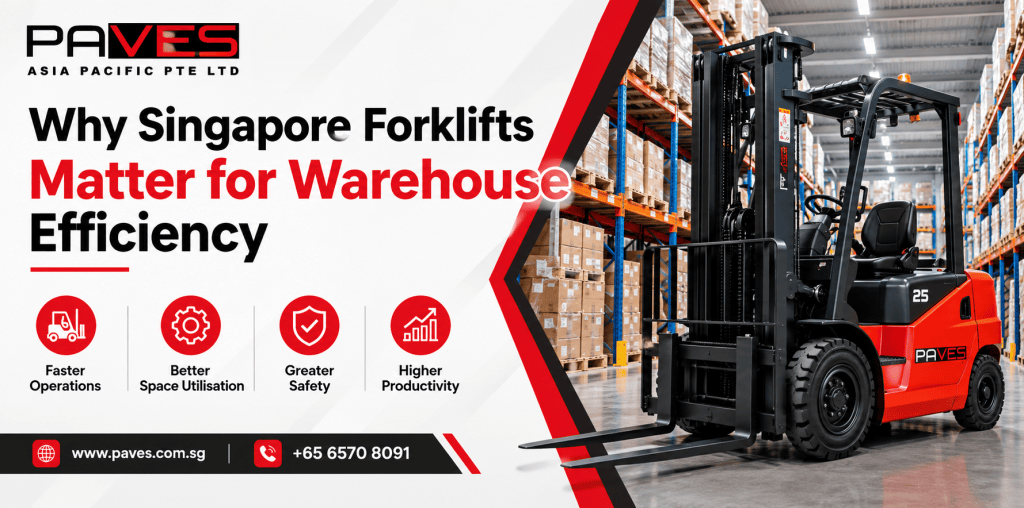
Businesses that handle warehousing, manufacturing, logistics, construction, and material movement need equipment that can perform consistently without creating unnecessary downtime. Choosing the right Singapore forklift solution can improve lifting efficiency, workplace safety, and overall operational productivity.
Reliable forklifts are designed to handle demanding workloads while giving businesses greater control over daily material-handling activities.
Why Do Businesses Choose Reliable Forklift Solutions?
Businesses prefer reliable forklift solutions because they provide:
- Better material-handling efficiency
- Improved workplace safety
- Reduced equipment downtime
- Greater lifting and manoeuvring flexibility
- Lower long-term operating costs
- Suitable options for different warehouse layouts
- Access to electric and specialised forklift models
- Better productivity during repetitive lifting operations
The right forklift should match the load capacity, operating environment, aisle width, lifting height, power requirements, and frequency of use. Selecting equipment based on these factors helps businesses achieve dependable performance instead of simply choosing a machine based on its initial price.
What Makes a Forklift Solution Reliable?
Reliability involves more than whether a forklift starts and operates properly. A dependable material-handling solution should perform consistently under the conditions in which it will be used.
Several factors determine reliability, including:
- Build quality: Strong components help equipment withstand regular use.
- Load capacity: The forklift should safely handle the required weight.
- Operator control: Smooth steering, braking, lifting, and lowering improve handling.
- Maintenance support: Regular servicing can reduce unexpected breakdowns.
- Energy efficiency: Efficient equipment can help control operating expenses.
- Application suitability: The machine should be appropriate for the working environment.
Businesses that carefully evaluate these factors can select equipment that supports long-term operational requirements.
Improving Productivity With the Right Forklift
Material movement can consume a considerable amount of time when businesses depend on manual handling or unsuitable machinery. A properly selected forklift can move pallets, containers, raw materials, and finished products more efficiently.
For example, warehouses with frequent loading and unloading activities may benefit from equipment designed for repetitive lifting. Manufacturing facilities may require forklifts capable of moving heavy materials between different production areas.
Choosing the appropriate forklift Singapore businesses need for their specific application can also reduce unnecessary movement. Operators can complete tasks more efficiently when the equipment provides appropriate lifting capacity, manoeuvrability, and visibility.
Productivity improvements can come from:
- Faster pallet movement
- Reduced manual handling
- Easier loading and unloading
- Better use of warehouse space
- Improved movement through narrow areas
- More consistent material-handling operations
The objective is not simply to move materials faster. It is to create a smoother workflow where equipment, operators, storage areas, and transportation processes work together.
Supporting Workplace Safety
Safety is one of the most important considerations when selecting material-handling equipment. Forklifts are powerful machines, and improper operation or unsuitable equipment can increase workplace risks.
Reliable equipment can contribute to safer operations when combined with proper operator training, maintenance, load management, and workplace procedures.
Businesses should consider features such as:
- Clear operator visibility
- Stable load handling
- Responsive braking
- Smooth steering
- Appropriate lifting controls
- Suitable load capacity
- Ergonomic operator controls
It is equally important to ensure that operators understand the machine’s capabilities and limitations. Even advanced equipment requires responsible operation and regular inspections.
Choosing Between Different Forklift Options
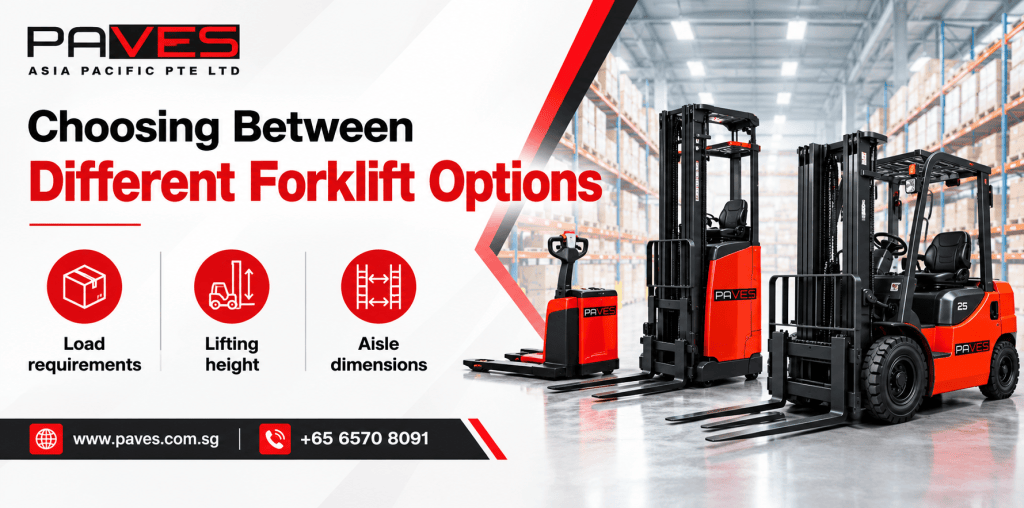
Different businesses have different material-handling requirements. A warehouse with narrow aisles may need a highly manoeuvrable machine, while a construction or industrial operation may require equipment capable of handling heavier loads.
Businesses researching forklifts for sale Singapore should first define their operational requirements rather than choosing a model solely because it has a lower purchase price.
Consider:
- Load requirements: Determine the typical and maximum loads.
- Lifting height: Identify the required lifting and stacking height.
- Aisle dimensions: Check whether the forklift can manoeuvre comfortably.
- Operating hours: Estimate how frequently the equipment will be used.
- Surface conditions: Consider indoor floors, outdoor areas, ramps, or uneven surfaces.
- Power source: Compare electric and other suitable power options.
- Maintenance requirements: Understand servicing and replacement needs.
This approach makes it easier to identify equipment that provides practical value over its operating life.
Why Electric Forklifts Are Gaining Attention
Electric forklifts can be a suitable choice for businesses looking for efficient equipment for indoor and controlled working environments. They can offer quiet operation and avoid direct exhaust emissions during use, making them particularly useful for warehouses, distribution centres, and certain manufacturing facilities.
Businesses considering an electric forklift for sale Singapore should evaluate battery capacity, charging arrangements, operating hours, load requirements, and available charging space.
Electric models may be especially appropriate where:
- Noise needs to be controlled
- Indoor air quality is important
- Regular charging can be accommodated
- Operating conditions are suitable for electric equipment
- Businesses want to consider energy-efficient material handling
However, the right choice depends on the specific application. Battery charging time, workload, operating shifts, and infrastructure should all be considered before purchasing.
When a Multi Directional Forklift Can Help
Some businesses deal with long, bulky, or awkward loads that can be difficult to manoeuvre using conventional forklift configurations. In these situations, specialised equipment can provide greater flexibility.
A multi directional forklift for sale can be worth considering when operations require movement in different directions, particularly where space is limited or long loads need to be handled.
Potential applications include handling:
- Long timber
- Steel products
- Pipes
- Construction materials
- Panels
- Other oversized loads
Its ability to manoeuvre differently from conventional equipment can help businesses use available floor space more effectively. However, operators should still evaluate load dimensions, aisle layouts, turning requirements, and working conditions before selecting this type of forklift.
Reducing Long-Term Operating Costs
The purchase price is only one part of the total cost of owning material-handling equipment. Businesses should also consider maintenance, energy consumption, downtime, operator productivity, replacement parts, and equipment lifespan.
Reliable equipment can help reduce unexpected interruptions. Preventive maintenance is particularly important because identifying worn components early can prevent larger mechanical problems.
A sensible cost evaluation should include:
- Initial purchase or rental cost
- Maintenance expenses
- Energy or fuel consumption
- Replacement components
- Expected service life
- Operator productivity
- Potential downtime
This broader approach helps businesses evaluate the actual value of a forklift instead of focusing only on the upfront investment.
Maintenance Keeps Forklifts Dependable
Even high-quality equipment requires regular maintenance. Inspections and servicing can help identify issues before they affect daily operations.
Businesses should establish maintenance routines covering areas such as:
- Tyres and wheels
- Forks and attachments
- Hydraulic systems
- Brakes
- Steering components
- Batteries and charging systems
- Warning systems
- Lifting mechanisms
Operators should also conduct appropriate pre-use checks and report unusual sounds, leaks, steering problems, or lifting issues promptly.
A proactive maintenance approach can extend equipment life and support more predictable operations.
Why Application-Based Selection Matters
There is no single forklift that is ideal for every business. A distribution warehouse, construction company, manufacturing plant, and logistics facility may have completely different requirements.
The selection process should begin by understanding the job. Businesses should identify the type of materials being moved, average load weights, operating environment, available space, lifting height, working hours, and required manoeuvrability.
Once these requirements are clear, businesses can compare suitable models and determine whether purchasing, leasing, or another equipment arrangement makes the most practical sense.
Conclusion
Reliable forklift solutions can give businesses better control over material movement, improve productivity, support workplace safety, and help manage long-term operating costs. The best choice depends on the specific application, including load requirements, warehouse layout, lifting height, operating hours, and power needs.
Businesses should compare equipment carefully and prioritise reliability, serviceability, and suitability rather than focusing only on the initial purchase price.
Paves can help businesses evaluate suitable material-handling options based on their operational requirements and equipment needs. Choosing the right solution from the beginning can create a more efficient and dependable workflow.
Frequently Asked Questions
What should businesses consider before choosing a forklift?
Businesses should consider load capacity, lifting height, aisle width, operating environment, usage frequency, power source, manoeuvrability, maintenance requirements, and total operating costs.
Are electric forklifts suitable for warehouses?
Electric forklifts can be suitable for many indoor warehouse applications, particularly where quiet operation and reduced direct exhaust emissions are desirable. Battery capacity and charging requirements should be evaluated before selection.
How do businesses choose forklifts for sale?
Businesses should first identify their material-handling requirements and then compare equipment based on capacity, dimensions, lifting height, operating costs, safety features, maintenance, and suitability for the working environment.
When is a multi directional forklift useful?
Multi directional models can be useful when businesses regularly handle long or bulky loads and need greater manoeuvrability in restricted spaces.
Why is forklift maintenance important?
Regular maintenance helps identify potential problems early, supports safer operation, reduces unexpected downtime, and can help extend the useful operating life of equipment.
For More Details :
Contact No : +65 6570 8091
E – Mail : sales@paves.com.sg


Leave a comment