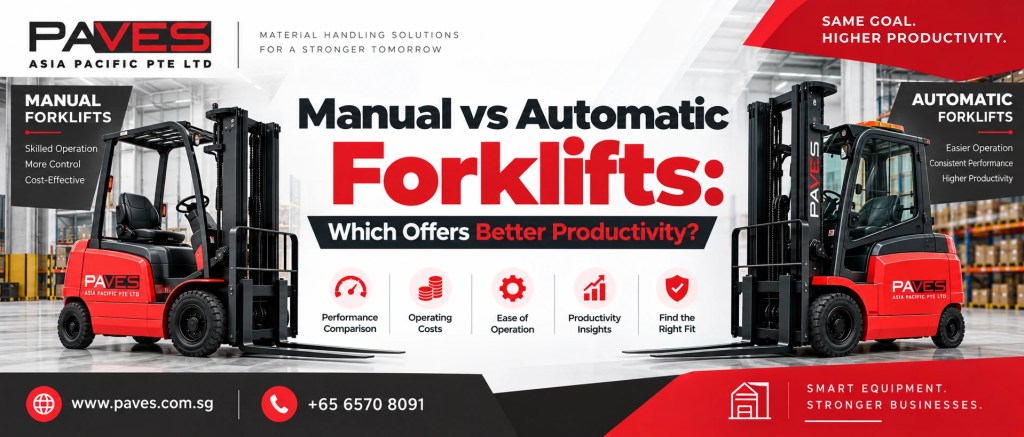
Choosing the right forklift can directly affect warehouse productivity, operating costs, and workplace efficiency. Businesses comparing a forklift Singapore solution often need to decide between conventional manual-control forklifts and more automated forklift technologies. The right choice depends on the type of work, warehouse layout, operating hours, load requirements, and available budget.
For businesses exploring a Singapore forklift, the decision should not be based simply on whether one machine is manual or automatic. Instead, consider how each option performs in your current working environment. Whether you’re comparing an electric forklift for sale specialised equipment such as a Combilift forklift for sale, understanding the differences can help you choose equipment that delivers better productivity over time.
Are Manual or Automatic Forklifts More Productive?
Automatic forklift technology can offer higher productivity in repetitive and predictable operations because it can reduce manual control requirements and support consistent material movement. However, manual forklifts can be more flexible for applications requiring frequent operator decisions and changing tasks.
The better option depends on:
- Type and frequency of material handling
- Warehouse layout
- Load characteristics
- Required travel distance
- Operating hours
- Level of automation needed
- Operator availability
- Initial investment
- Maintenance requirements
For many traditional warehouse applications, a well-maintained manual forklift remains highly productive. Automation becomes more attractive when operations involve repetitive routes, predictable workflows, and high-volume material movement.
What Is a Manual Forklift?
A manual forklift is controlled directly by an operator who manages steering, movement, lifting, and load positioning. The operator continuously makes decisions based on the warehouse environment and the task being performed. Manual forklifts are widely used across warehouses, manufacturing facilities, logistics operations, and construction environments.
Their main advantage is flexibility. Operators can quickly respond to changing loads, obstacles, pedestrians, and unexpected warehouse conditions. When searching for a forklift truck for sale, businesses can find manual models in various capacities, mast configurations, and power types.
What Is an Automatic Forklift?
An automatic forklift uses automation technologies to perform some or many movement-related tasks with reduced direct operator control. Depending on the system, automated forklifts may use sensors, navigation systems, software, cameras, or predefined routes. The level of automation varies significantly between models and applications.
Automatic systems are particularly useful where material movement follows predictable patterns, such as transporting pallets between designated warehouse areas. They can help businesses standardise repetitive tasks and potentially reduce the amount of manual intervention required for routine movements.
1. Productivity and Operating Speed
Productivity is often the main reason businesses compare manual and automatic forklifts. Manual forklifts can be highly productive when operators are experienced and the workflow changes frequently. An operator can immediately adjust the forklift’s movement according to current conditions.
Automatic forklifts can provide consistent performance in repetitive workflows. When routes, pickup points, and drop-off locations are predictable, automation can help streamline material movement. However, automation doesn’t automatically mean faster operations. Poor warehouse layout, inefficient routes, or unsuitable automation technology can limit productivity.
2. Operator Dependency
Manual forklifts depend heavily on skilled operators. Their performance can vary depending on experience, workload, fatigue, and operating conditions. Automatic forklifts can reduce operator involvement in repetitive tasks. This can be particularly useful in operations where businesses want to reduce the amount of manual driving required.
However, automated systems still require people for supervision, maintenance, system management, exception handling, and other warehouse responsibilities. Therefore, automation changes the operator’s role rather than necessarily eliminating human involvement entirely.
3. Flexibility in Different Applications
Manual forklifts generally have an advantage when flexibility is important.
An operator can:
- Change routes immediately
- Handle unexpected loads
- Respond to obstacles
- Work in changing environments
- Perform different tasks during the same shift
Automatic forklifts work best when workflows are structured and predictable.
For companies comparing a Singapore forklift, consider how frequently your warehouse processes change. If routes and tasks vary throughout the day, a manual machine may offer greater practical flexibility.
4. Suitability for Electric Operations
Electric forklifts are becoming an important option for businesses looking for efficient material-handling equipment, particularly for indoor applications. If you’re researching an electric forklift for sale, consider both the forklift’s power system and its level of automation. An electric forklift can provide benefits such as quiet operation and no direct exhaust emissions during operation.
However, battery capacity, charging time, operating hours, and charging infrastructure should also be considered. Automation and electric power are separate considerations. An electric forklift does not necessarily mean the machine is automatic.
5. Warehouse Layout Matters
Warehouse design plays a major role in determining which forklift technology makes sense. Manual forklifts can operate across changing warehouse layouts with relatively little modification.
Automatic forklifts may require additional planning around:
- Travel routes
- Pickup and drop-off points
- Navigation
- Safety zones
- Charging areas
- Pedestrian movement
- Warehouse management systems
If your warehouse frequently changes its storage arrangement, a manual forklift may be easier to adapt. For fixed, high-volume workflows, automation may provide greater long-term value.
6. Safety Considerations
Safety is essential regardless of whether you choose manual or automatic equipment. Manual forklift safety depends significantly on operator training, visibility, workplace procedures, load stability, and appropriate operating practices. Automatic forklifts can incorporate sensors, navigation technology, obstacle detection, and controlled movement systems.
However, automated equipment still needs appropriate risk assessment, safeguards, maintenance, and workplace procedures. Pedestrian areas, intersections, loading zones, racks, and other equipment must be considered before introducing automated forklift technology. Businesses should follow applicable Singapore workplace safety requirements and the manufacturer’s operating instructions.
7. Maintenance and Downtime
Maintenance affects productivity regardless of forklift type. Manual forklifts require routine servicing of components such as tyres, brakes, hydraulics, batteries, controls, and other mechanical systems. Automatic forklifts may have additional technology-related components, including sensors, navigation systems, software, and electronic controls.
This means businesses should consider technical support and spare-parts availability when evaluating an electric forklift for sale or an automated solution. A machine that offers excellent performance but frequently experiences downtime may not provide the productivity expected from the investment.
8. Initial Investment vs Long-Term Value
Manual forklifts generally have a simpler operating concept and may require less investment in automation infrastructure. Automatic systems can require additional investment in technology, integration, navigation infrastructure, software, and system configuration. However, initial price should not be the only consideration.
Calculate the potential long-term value by considering:
- Labour requirements
- Operating hours
- Maintenance
- Energy consumption
- Downtime
- Productivity
- Warehouse utilisation
- Equipment lifespan
A higher initial investment can make sense if the system delivers measurable productivity improvements in a suitable application.
9. Specialised Forklift Applications
Not every warehouse requires a standard forklift. Some businesses have specialised handling requirements involving long loads, narrow spaces, or multiple-direction movement. For example, companies searching for a Combilift forklift for sale may be looking for equipment designed for specialised material-handling applications.
The key is to match the equipment to the actual task rather than choosing automation simply because it appears more advanced. A specialised manual forklift can sometimes provide greater productivity than an automated standard forklift that isn’t designed for the specific application.
10. Choosing the Right Option for Your Business
There is no universal answer to whether manual or automatic forklifts are better.
A manual forklift may be the better choice when:
- Workflows change frequently
- Operators need high flexibility
- Loads vary significantly
- The warehouse has changing routes
- Initial investment needs to remain controlled
An automatic forklift may be more suitable when:
- Material movement is repetitive
- Routes are predictable
- Work volumes are high
- Standardization is important
- The warehouse can support automation infrastructure
When comparing equipment with Paves Asia Pacific, businesses should evaluate forklift specifications, application requirements, operating conditions, maintenance support, and long-term costs rather than focusing only on automation.
Manual vs Automatic Forklift: Quick Comparison
| Factor | Manual Forklift | Automatic Forklift |
|---|---|---|
| Operator involvement | High | Reduced for automated tasks |
| Flexibility | High | Best in predictable workflows |
| Repetitive tasks | Operator dependent | Well suited |
| Initial investment | Generally lower | Generally higher |
| Warehouse changes | Easier to adapt | May require reconfiguration |
| Automation | Limited | Higher |
| Maintenance | Conventional systems | May include technology systems |
| Best suited for | Flexible operations | Repetitive, structured operations |
Final
Manual and automatic forklifts can both deliver excellent productivity when matched to the right application. The key difference is how your warehouse operates. If your business needs flexibility and operators regularly handle changing tasks, a manual forklift may be the more practical option. If your operation involves repetitive routes and predictable material movement, automation may offer greater efficiency and consistency.
Before choosing a forklift truck for sale, evaluate your workflow, warehouse layout, operating hours, safety requirements, maintenance needs, and total cost of ownership. The right equipment should improve productivity while fitting naturally into your existing operations.
FAQs
Q1. Is an automatic forklift more productive than a manual forklift?
A1. Not always. Automatic forklifts can improve productivity in repetitive and predictable workflows, while manual forklifts can be more productive when tasks change frequently and operator flexibility is important.
Q2. Are electric forklifts automatic?
A2. No. Electric describes the forklift’s power source, while automatic describes its control or operating system. An electric forklift can be manually operated or incorporate automation technology.
Q3. What should I consider when buying a forklift in Singapore?
A3. Consider lifting capacity, lift height, warehouse dimensions, operating hours, power type, battery requirements, safety features, maintenance, total ownership cost, and supplier support.
Q4. Is an electric forklift for sale a good investment?
A4. An electric forklift can be a suitable investment for many indoor applications, but the right choice depends on workload, operating hours, charging infrastructure, load requirements, and total ownership costs.
Q5. What is a Combilift forklift used for?
A5. Combilift forklifts are designed for specialised material-handling applications and can be useful where businesses need specific manoeuvrability or load-handling capabilities. The appropriate model depends on the application.
Q6. Should I buy a manual or automatic forklift?
A6. Choose based on your workflow. Manual forklifts are generally better for flexible and changing operations, while automatic models can be advantageous for repetitive, predictable material-handling processes.


Leave a Reply