Buying your first forklift is a significant decision for businesses involved in warehousing, logistics, manufacturing, construction, and material handling. The right machine can improve productivity, reduce manual handling, and make daily operations more efficient. However, choosing the wrong model can result in unnecessary operating costs, limited maneuverability, or equipment that does not match your workload.
If you’re searching for forklift Singapore options or comparing a forklift truck for sale, it is important to look beyond the purchase price. Factors such as lifting capacity, mast height, fuel type, operating environment, maintenance, safety, and after-sales support should all be considered before making a decision.
What Should You Know Before Buying a Forklift in Singapore?
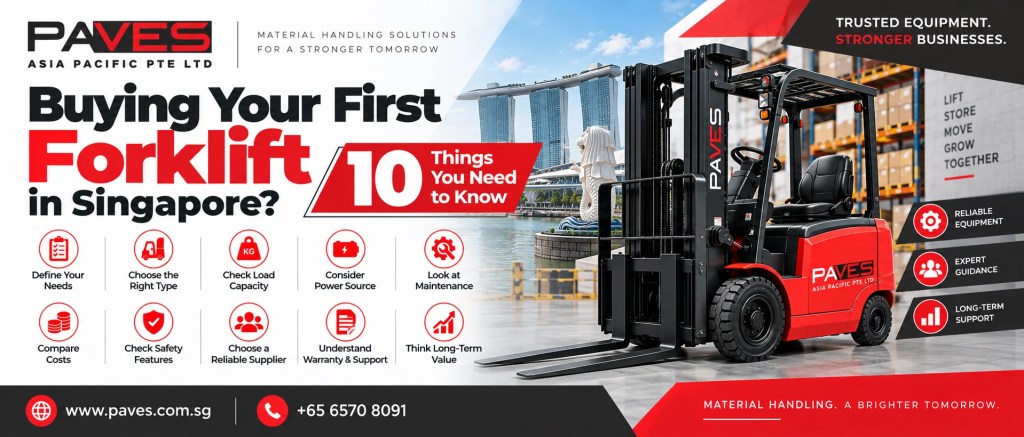
Before purchasing your first forklift in Singapore, focus on these 10 factors:
- Required lifting capacity
- Maximum lifting height
- Indoor or outdoor operating environment
- Electric, diesel, or other power options
- Forklift dimensions and turning radius
- Battery or fuel requirements
- Safety features
- Maintenance and spare parts
- Total ownership cost
- Supplier support and warranty
The best forklift is not necessarily the cheapest option. It should match your load requirements, warehouse layout, operating hours, working conditions, and long-term business needs.
1. Determine Your Required Lifting Capacity
The first step is understanding how much weight you need to lift regularly. Forklifts are designed for different load capacities, and exceeding the rated capacity can create serious safety and stability risks.
Consider your:
- Maximum load weight
- Typical pallet weight
- Load dimensions
- Load centre
- Frequency of lifting
- Required lifting height
Don’t select a forklift based only on your average load. Consider the heaviest loads you expect to handle during normal operations. When comparing a forklift truck for sale, provide suppliers with accurate load information so they can recommend an appropriate capacity.
2. Consider the Required Lifting Height
Capacity isn’t the only specification that matters. You also need to determine how high the forklift must lift your loads. If your warehouse uses high storage racks, you may need a forklift with a suitable mast configuration and lifting height.
Before purchasing a Singapore forklift, check:
- Maximum rack height
- Required clearance
- Ceiling height
- Load dimensions
- Mast height
- Overhead obstructions
A forklift with insufficient lifting height may limit your storage capacity and reduce warehouse efficiency.
3. Choose the Right Power Type
Forklifts are available with different power systems, and your operating environment should influence your choice. Electric forklifts can be suitable for many indoor applications because they don’t produce direct exhaust emissions during operation. They may also provide quieter operation compared with combustion-powered equipment.
If your operations involve outdoor areas, heavy-duty applications, uneven surfaces, or extended operating periods, other forklift configurations may be more appropriate. If you’re specifically searching for an electric forklift for sale, compare battery capacity, charging requirements, operating time, and available charging infrastructure before purchasing.
4. Check Your Warehouse Layout
A forklift that works perfectly in one warehouse may not work efficiently in another.
Measure:
- Aisle width
- Doorway dimensions
- Turning areas
- Loading bays
- Rack spacing
- Ramp access
- Floor conditions
Compact warehouses may require forklifts with a smaller turning radius and better manoeuvrability. Before buying a forklift Singapore model, make sure the machine can comfortably move through your actual working environment.
5. Think About Your Daily Operating Hours
Your working schedule affects the type of forklift you should purchase.
Ask yourself:
- How many hours will the forklift operate each day?
- How many shifts do you run?
- How frequently will it lift loads?
- Will the machine operate continuously?
- How much downtime can you tolerate?
For businesses operating multiple shifts, battery charging and replacement options become particularly important when considering an electric model. For lower-intensity applications, a smaller machine may provide better overall value than purchasing an oversized forklift.
6. Compare Battery and Charging Requirements
If you’re considering an electric forklift for sale, pay close attention to the battery system.
Important factors include:
- Battery type
- Battery capacity
- Charging time
- Expected operating hours
- Charging infrastructure
- Battery replacement cost
- Availability of technical support
The purchase price is only part of the cost. Battery maintenance and replacement can affect the long-term economics of an electric forklift. Make sure your facility has an appropriate charging area and operating process before purchasing.
7. Check Safety Features
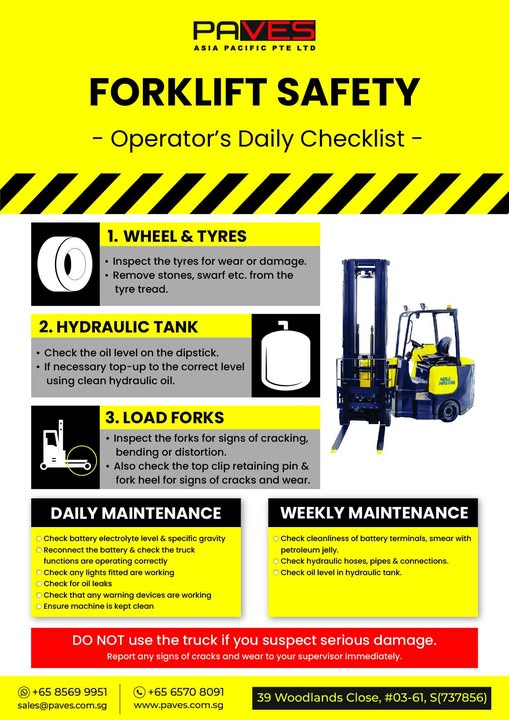
Safety should be one of the highest priorities when buying a forklift. Depending on the model, features may include:
- Operator restraints
- Warning lights
- Horns
- Reverse alarms
- Visibility aids
- Speed-control functions
- Stability systems
- Operator protection features
You should also consider pedestrian traffic, loading areas, narrow aisles, ramps, and interactions with other warehouse vehicles. Forklifts should be operated by properly trained and authorized operators in accordance with applicable Singapore workplace safety requirements and manufacturer instructions.
8. Understand Maintenance and Spare Parts
A forklift is a working asset, so maintenance should be considered before purchase rather than after a breakdown occurs.
Ask the supplier:
- How often does the forklift require servicing?
- Are spare parts readily available?
- Who provides maintenance?
- What is covered under warranty?
- How quickly can technical support respond?
- What are the estimated maintenance costs?
Reliable access to service and spare parts can reduce unexpected downtime. When evaluating Paves Asia Pacific, consider not just the forklift specifications but also the availability of ongoing service and support for your equipment.
9. Calculate the Total Cost of Ownership
The purchase price doesn’t tell you the complete cost of owning a forklift.
Your total cost may include:
- Purchase price
- Delivery
- Installation or commissioning
- Electricity or fuel
- Battery costs
- Maintenance
- Spare parts
- Operator training
- Insurance
- Repairs
- Replacement components
For example, an electric forklift may have different running and maintenance costs compared with a combustion-powered model. Instead of asking, “Which forklift is cheapest?”, ask, “Which forklift offers the best value over its expected working life?” This approach can help you make a more informed investment decision.
10. Compare Different Forklift Models and Suppliers
Don’t rush into the first deal you find. Compare multiple machines and suppliers based on specifications, service, warranty, availability, and total ownership costs. If your application requires specialized equipment, you may also come across options such as Combi lift forklifts for sale.
These forklifts are designed for specific material-handling applications and can be worth considering where multidirectional handling or specialized load requirements are involved.
Before purchasing, compare:
| Factor | What to Check |
|---|---|
| Capacity | Maximum load requirement |
| Lift height | Required rack height |
| Power | Electric or combustion |
| Dimensions | Aisle and turning space |
| Battery | Capacity and charging |
| Safety | Operator and workplace features |
| Maintenance | Service and spare parts |
| Warranty | Coverage and duration |
| Cost | Purchase and running costs |
| Support | Supplier response and service |
A supplier that understands your application can help you select equipment that is better suited to your actual requirements.
Forklift Singapore Buying Checklist
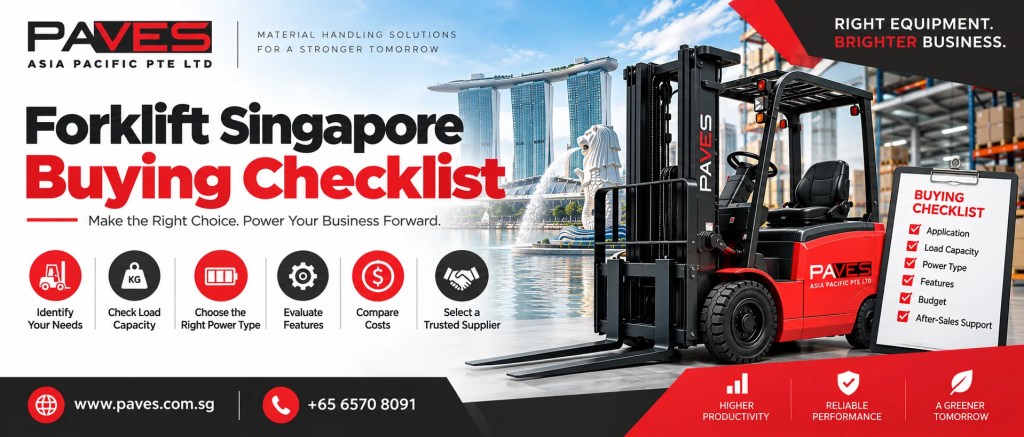
Before finalising your purchase, ask yourself:
- What is the heaviest load I need to lift?
- How high must I lift it?
- How wide are my warehouse aisles?
- Will the forklift operate indoors, outdoors, or both?
- How many hours will it operate each day?
- Is electric power suitable for my application?
- What charging or fuel infrastructure is required?
- What safety features do my operators need?
- What will maintenance cost over time?
- Does the supplier provide reliable after-sales support?
Answering these questions can significantly narrow your choices.
FAQs
Q1. What should I consider when buying a forklift in Singapore?
A1. Consider lifting capacity, lifting height, operating environment, forklift dimensions, power type, battery or fuel requirements, safety features, maintenance, total ownership cost, and supplier support.
Q2. Is an electric forklift suitable for warehouses?
A2. An electric forklift can be suitable for many indoor warehouse applications. Its suitability depends on load requirements, operating hours, floor conditions, charging facilities, and the specific forklift model.
Q3. What should I check when buying a forklift truck for sale?
A3. Check the forklift’s rated capacity, lifting height, condition, operating hours, safety equipment, maintenance history, warranty, spare-parts availability, and total ownership costs.
Q4. Should I buy a new or used forklift?
A4. A new forklift can offer the latest features and manufacturer support, while a used forklift may have a lower initial purchase price. Compare condition, maintenance history, warranty, expected operating life, and total costs.
Q5. What is a Combilift forklift used for?
A5. Combilift forklifts are designed for specialised material-handling applications where manoeuvrability and handling different load types are important. Check the specific model’s specifications to determine whether it fits your operation.
Q6. Where can I find an electric forklift for sale in Singapore?
A6. Compare established suppliers based on available models, specifications, pricing, warranty, spare parts, maintenance support, and suitability for your operating environment.


Leave a Reply