
Choosing the right singapore forklift material-handling equipment can directly affect warehouse productivity, storage capacity, safety, and operating costs. Different warehouse layouts require different forklift configurations, from standard counterbalance trucks to narrow-aisle and multi-directional models. Understanding these options helps warehouse managers select equipment that matches their loads, aisle dimensions, lifting heights, and daily workflow.
1. Electric Counterbalance Forklifts
Electric counterbalance forklifts are among the most versatile choices for indoor warehouse operations. They use a rear counterweight to balance loads carried on the front forks, allowing operators to lift and transport palletised goods efficiently.
Electric models are particularly suitable for enclosed warehouses because they produce no direct exhaust emissions and generally provide quieter operation than combustion-powered alternatives. They can be used for loading and unloading, pallet movement, staging, and general material handling.
When looking for a forklift Singapore warehouse solution, businesses should consider the required load capacity, battery technology, charging arrangements, aisle width, and lifting height before selecting an electric counterbalance model.
2. Reach Trucks
Reach trucks are designed specifically for warehouses where vertical storage and narrow aisles are important. Their reach mechanism allows the forks to extend toward racking, making it possible to place and retrieve pallets without requiring the entire machine to move as close to the rack as a conventional counterbalance truck.
They are particularly useful in distribution centres, high-density storage facilities, and warehouses where floor space is limited. Reach trucks are generally designed for smooth indoor floors and high-racking applications.
Businesses comparing forklifts for sale Singapore options should assess their rack height and aisle dimensions before deciding whether a reach truck is more appropriate than a standard counterbalance forklift.
3. Very Narrow Aisle Forklifts
Very narrow aisle, or VNA, forklifts are built to maximise storage density. They can operate in substantially narrower aisles than conventional warehouse trucks and are designed for facilities that make extensive use of vertical racking.
For example, the Aisle Master range supplied by PAVES is designed for VNA applications, with models capable of operating in aisles as narrow as 1.6 metres and lifting loads up to 3,000 kg to heights of up to 12 metres, depending on configuration.
VNA equipment is worth considering when warehouse managers want to increase pallet positions without expanding the building footprint. However, aisle dimensions, floor conditions, rack design, and traffic flow must be assessed before installation.
4. Pallet Trucks
Pallet trucks are compact machines used to move palletised goods horizontally. They are especially useful for receiving areas, dispatch zones, retail warehouses, and short-distance transportation.
Electric pallet trucks can reduce physical effort compared with manual pallet jacks and are suitable for operations involving frequent pallet movement. They are not normally intended for the same high-level racking applications as reach or VNA trucks.
Their compact size makes them a practical addition to larger forklift fleets, particularly when goods need to be moved quickly between staging and storage areas.
5. Stackers
Stackers provide lifting and stacking capability while maintaining a relatively compact footprint. They can be useful for smaller warehouses, storage rooms, retail operations, and applications involving lighter loads.
Depending on the model, stackers may be pedestrian-operated or designed with an operator platform. They are often appropriate where a full-sized counterbalance forklift would be unnecessarily large for the application.
Before choosing a stacker, warehouse operators should check maximum load capacity, lifting height, turning radius, battery requirements, and the available aisle space.
6. Order Pickers
Order pickers are designed for warehouses where workers need to access products directly from storage locations. Instead of simply moving complete pallets, an order picker allows the operator to work at different heights while selecting individual products.
They are especially useful in e-commerce, retail distribution, spare-parts storage, and facilities with high numbers of individual stock-keeping units.
Some specialised electric order-picking equipment can operate in extremely narrow aisles. For example, the Combi-OP range is designed for guided narrow aisles and can operate in aisles as narrow as 1.4 metres, depending on the application.
7. Multi-Directional Forklifts
Multi-directional forklifts are designed for applications where conventional forward-and-backward steering is not enough. Their wheels can be configured to allow movement in multiple directions, making them particularly useful for long loads such as timber, steel, pipes, aluminium, and other bulky materials.
The major advantage is maneuverability. A multi-directional truck can travel sideways with long loads, reducing the space needed to turn inside a warehouse. This can be particularly valuable where long materials need to be stored in narrow aisles.
A Combilift CBE, for example, combines characteristics of a narrow-aisle, sideloader, and counterbalance truck. Its four-way steering enables sideways travel, while available configurations include electric and diesel power.
Companies searching for a forklift for sale should evaluate load dimensions as carefully as load weight. The truck needs to accommodate the length, width, centre of gravity, and handling pattern of the materials.
8. Articulated Forklifts
Articulated forklifts are designed to combine forklift functionality with improved maneuverability in confined spaces. Their articulated chassis allows the machine to negotiate narrow aisles while handling palletised goods.
They can be useful for warehouses that need a combination of indoor and outdoor capability. The Aisle Master range, for instance, is designed for narrow-aisle applications while also supporting indoor and outdoor operation.
This type of forklift can be particularly attractive when a warehouse wants to reduce the need for separate equipment for different handling areas.
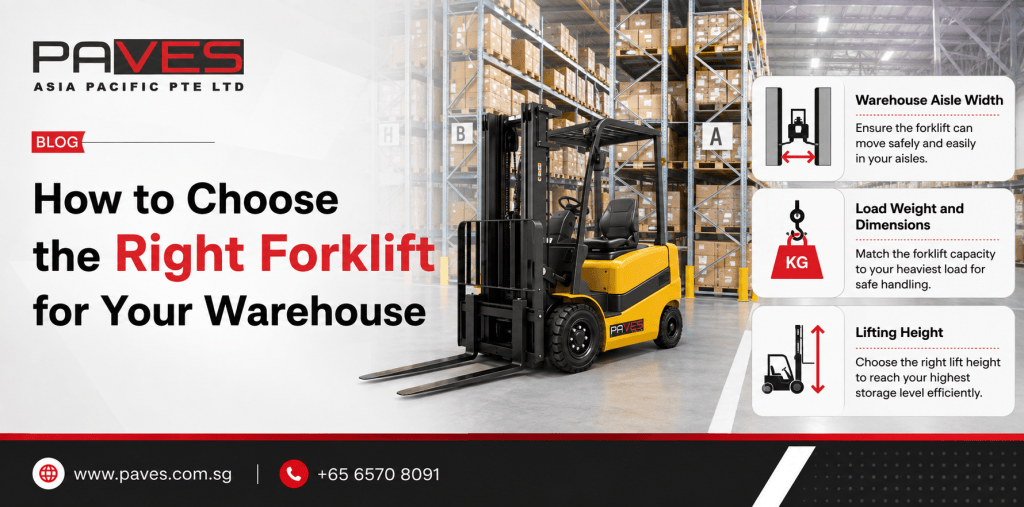
How to Choose the Right Forklift for Your Warehouse
Selecting equipment should begin with the actual operating conditions rather than the machine’s appearance or headline capacity. Consider these factors:
Warehouse Aisle Width
Measure the narrowest operating aisle, not simply the average aisle. A standard counterbalance truck may require considerably more space than a reach, VNA, or multi-directional model.
Load Weight and Dimensions
Check the heaviest load as well as its dimensions. Long or unstable loads may require specialised equipment even when their weight falls within the capacity of a standard forklift.
Lifting Height
Review the maximum rack height and required pallet placement height. A truck’s rated capacity can change at greater lifting heights, so the specification should be checked at the actual operating height.
Indoor or Outdoor Operation
Electric equipment is often suitable for enclosed environments, while certain diesel or other combustion-powered models may be better suited to outdoor heavy-duty applications. Surface conditions, ventilation, weather exposure, and operating hours should all be considered.
Battery and Charging Requirements
For electric equipment, consider battery capacity, charging time, charging infrastructure, shift patterns, and whether opportunity charging or interchangeable batteries are required.
Safety and Operator Requirements
The selected forklift should match the workplace layout and the training requirements of operators. Load stability, visibility, pedestrian traffic, rack protection, floor conditions, and speed control should all form part of the assessment.
Forklifts for Sale: What Should Buyers Compare?
When comparing electric forklift for sale Singapore options, avoid choosing solely on purchase price. Compare total operating costs, warranty support, battery requirements, maintenance, spare parts availability, capacity, lifting height, and expected utilisation.
For specialised operations, compare the productivity gained from a machine against the cost of purchasing multiple conventional forklifts. A multi-directional truck may handle several types of loads and travel patterns, potentially reducing the need for separate equipment.
The same approach applies when evaluating forklifts for sale Singapore for high-density warehouses. A machine that fits a narrow aisle but cannot safely handle the required load or lifting height will not provide a practical long-term solution.
Frequently Asked Questions
What is the most versatile forklift for a warehouse?
An electric counterbalance forklift is a versatile choice for many general indoor applications. However, reach, VNA, articulated, or multi-directional forklifts may be more suitable when aisle space, storage height, or load dimensions create specific requirements.
When should I choose a multi-directional forklift?
Choose a multi-directional forklift when your operation regularly handles long or awkward loads and requires sideways movement in confined spaces. These trucks can be particularly useful for industries handling steel, timber, pipes, and other lengthy materials.
Is an electric forklift suitable for indoor warehouses?
Yes. Electric forklifts are commonly suited to indoor applications because they provide quiet operation and produce no direct exhaust emissions. Battery capacity and charging arrangements should be matched to the warehouse’s operating schedule.
What is a VNA forklift used for?
A VNA forklift is designed for very narrow aisles and high-density storage. It can help warehouses make better use of vertical and floor space when the facility has suitable racking, flooring, and aisle configurations.
Final Thoughts
Every warehouse has different material-handling requirements, so there is no single forklift that is ideal for every operation. Counterbalance forklifts work well for general pallet handling, reach and VNA trucks support high-density storage, pallet trucks and stackers assist with lighter movement, and multi-directional or articulated forklifts can solve specialised space and load-handling challenges.
The right forklift Singapore solution should be selected after evaluating aisle width, load characteristics, lifting height, floor conditions, operating environment, safety requirements, and total ownership costs. Paves provides a range of material-handling solutions designed around warehouse space utilisation and specific operational requirements.
A careful equipment assessment can help warehouse operators improve workflow, use storage space more efficiently, and select machinery that supports long-term productivity rather than simply meeting an immediate handling requirement.
For More Details :
Contact No : +65 6570 8092
E – Mail : sales@paves.com.sg


Leave a Reply